

Trends in the CX industry are evolving rapidly. BPOs are revising pricing structures. As technology becomes increasingly integrated, organizations are prioritizing measurable outcomes over FOMO and exaggerated marketing claims.
The effectiveness of AI relies on quality data, proper oversight, and careful application to relevant scenarios. Meanwhile, human agents play an even more crucial role during key interactions that influence brand loyalty, trust, and retention.
Is your organization ready to navigate the challenges ahead? Read on.
Outcome-Based Models
A systematic shift is happening in the CX outsourcing industry. Progressing from traditional labor-arbitrage models to outcome-based frameworks moves payment structures away from per-FTE pricing toward compensation tied directly to measurable business and customer outcomes. Industry analysts view this as one of the most significant commercial transformations in the history of outsourcing. Here’s what it looks like on paper:
For an organization to hire a full-time team of agents, it typically costs $8-$15 per hour for offshore delivery and $28-$45 per hour for onshore operations. With traditional seat-based BPO models, organizations pay agents between $8 and $30 per hour. This presents a value in savings. With the per-resolution BPO model, however, organizations pay $1 to $5 per resolution.
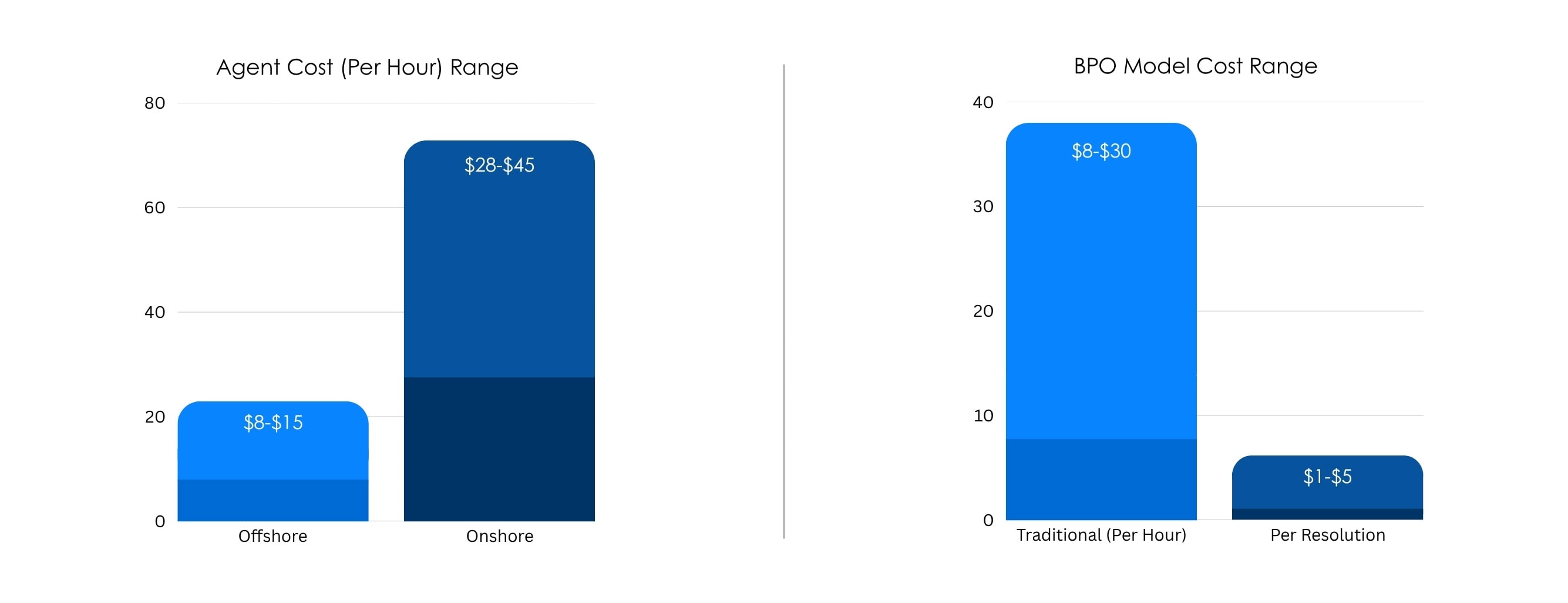
Moving from a seat-based pricing model to an outcome-based model moves the reward from scale and capacity to efficiency, performance, and customer impact. According to Gartner, organizations adopting outcome-based pricing models over the next three years are expected to realize significant operational and financial advantages.
Technology Ramp Up
In the early stages of AI adoption, many organizations hesitated to commit. Concerns about technical complexity, security gap concerns, internal skill gaps, data readiness, and uncertainty surrounding ROI were roadblocks. And while some AI solutions have out-of-the-box functionality, most still require customization, integration, and operational specialization to deliver meaningful results.
However, as early adopters continue to demonstrate measurable gains, we are seeing a substantial upturn in the number of organizations looking to implement AI-powered technologies. What’s more, it’s across all industries.
Organizations are starting small-scale first. This may mean deploying five operational AI units during an initial three-month pilot period. Then, scale for broader enterprise adoption once value is proven. In many cases, successful pilots lead directly to large-scale rollouts of hundreds.
Performance Over Promises
I’ll follow this up by saying that as more organizations adopt AI, they expect measurable outcomes. Forrester forecasted in the Predictions 2026: Artificial Intelligence report that buyers would no longer be overpersuaded by marketing techniques alone.
The initial adopters were captivated by FOMO or a need to keep up with the competition. But things have changed. This shift signals a broader maturation of the AI market. The conversation is shifting from what AI could potentially do to what it is accomplishing. Practical tools that align with organizational objectives are the only way forward.
Practical AI

AI is only as good as its data. What’s more, it needs to be governed, maintained and applied to the right use cases. This requires careful planning. It’s not a one-size-fits-all approach.
AI delivers the greatest value when it is aligned with business priorities rather than implemented because it is new or trending. Identify what needs to be achieved first. In retail, your organization may benefit from AI to personalize customer recommendations. In hospitality, it may mean faster service to enhance overall CX.
AI does not function without a capable team to manage all the challenges involved in its development, implementation, and maintenance. Forrester reports that 30% of large enterprises are mandating AI training due to low AI literacy and adoption rates. It takes a complete team effort, from upper management to the agents in the seats.
Impactfully Human
As the front line of your contact center, human agents have never been more valuable. As everyday tasks have become automated, customers who reach out require direct or specialized assistance.
What makes a successful agent beyond the baseline requirement of AI knowledge? Critical thinking skills are key. Even with AI assistance, agents must understand how to use the information provided and work to ensure customer satisfaction on a case-by-case basis. These moments of human connection are invaluable and greatly impact customer loyalty to your brand.
Finding top-quality agents takes a lot of effort through trial and error. Once each is part of an organization, it’s important to retain agents as part of the team. This includes paying a fair industry wage based on location, recognizing high achievers with rewards, and reducing the risk of burnout through preventative care.

In Conclusion
As BPO providers are rethinking pricing models, technology is increasingly embedded in the customer experience. Meanwhile, human agents remain indispensable in the moments that matter most to customers and brands. CX industry trends in 2026 are setting the stage for the future. Organizational success will require careful planning to sustain it.