

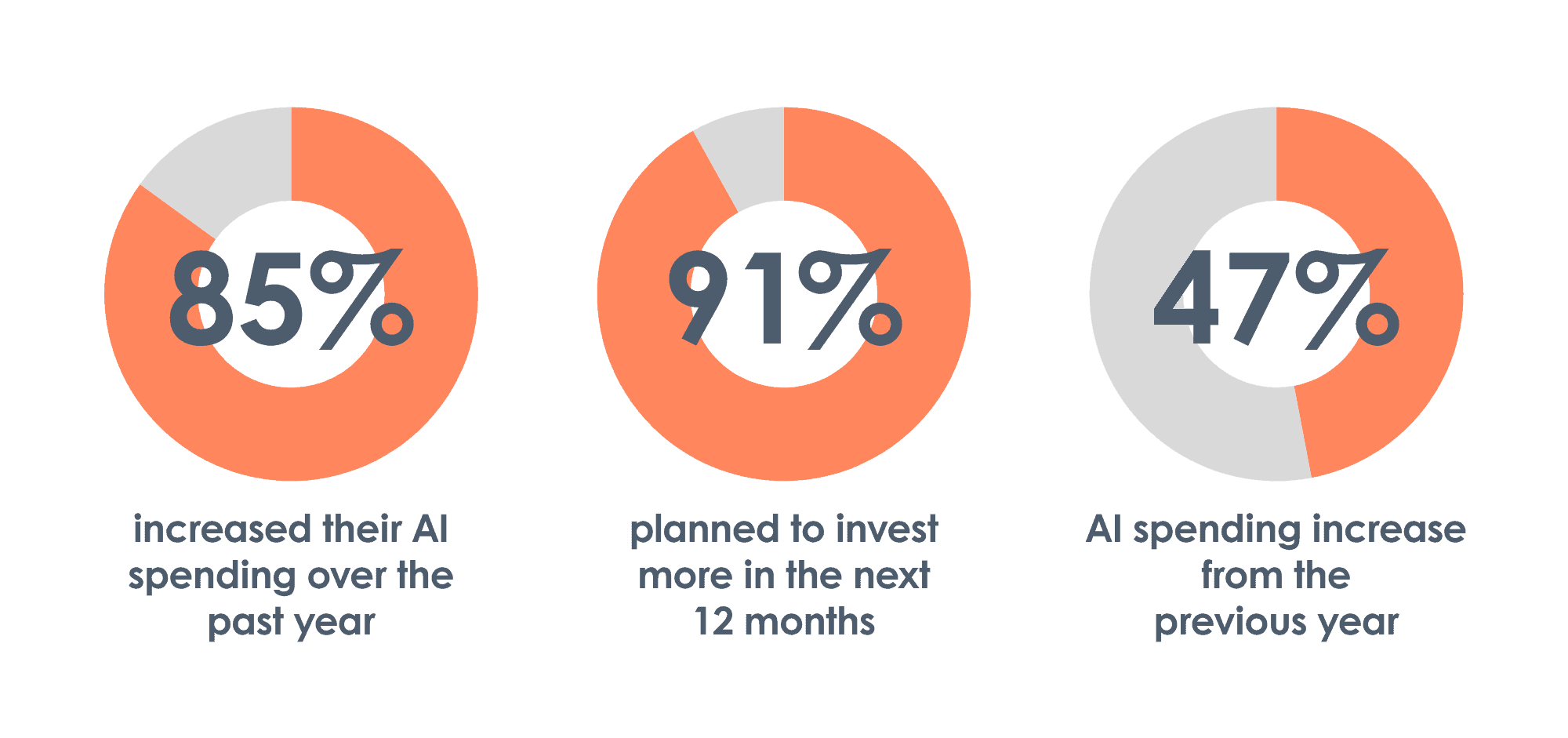
Organizations are racing to unlock AI’s competitive advantage. A recent Deloitte survey found that 85% of organizations increased their AI spending over the past year, and 91% said they planned to invest even more in the next 12 months. According to Gartner, worldwide spending on artificial intelligence is expected to reach $2.59 trillion this year, representing a 47% increase over the previous year.
MIT’s The GenAI Divide: State of AI in Business found that despite organizations investing an estimated $30–40 billion in generative AI, 95% have yet to achieve measurable return on investment. Only 5% of AI pilots have produced meaningful financial impact.
Why are so many AI initiatives falling short? Where’s the disconnect? Most importantly, what separates organizations generating real value from those that aren’t? Let’s take a closer look.
Success Stories
Take Walmart as an example of a GenAI success story. The new AI associates app streamlines tasks and improves service. Initially, the app helped overnight stocking teams prioritize tasks. Team leads reduced shift planning time from 90 to 30 minutes, which led to a rollout of the app to other departments.
Walmart has upgraded conversational AI tools for associates with GenAI. Now, the tools do more than answer specific questions. Instead, they can provide step-by-step guides on how to accomplish various in-store tasks to Walmart standards.
For customer service, Walmart introduced a real-time translation feature that enables associates to converse with customers in 44 languages. The speech-to-speech or text-to-text format is trained on Walmart-specific knowledge and instantly recognizes house brands.

Global AI spending in financial services now exceeds $20 billion annually, according to McKinsey. Morgan Stanley Wealth Management (MSWM) has adopted GenAI tools as part of its AI toolset for financial advisors, streamlining notetaking and allowing them to hone in on action items. Afterward, GenAI summarizes the points and drafts an email. Notes are saved to Salesforce. MSWM reported 98% adoption by the advisor team, saving 30 minutes per meeting.
Strategic Investments
Organizations that are successful with AI view it as a strategic investment that delivers real value. It needs to solve at least one of four meaningful business problems. How will these tools improve the employee experience, enhance the customer experience, improve efficiency, and reduce operating costs? And more importantly, do the expected benefits justify the investment?
Not every business challenge requires an AI solution. Instead of treating AI as the default, step back and evaluate whether it is the right answer. In other words, separate real need from FOMO.
AI and DATA
AI is only as good as the data that you give it. So, if your data is inaccurate, incomplete, inconsistent, duplicated, or biased, you have set AI and your organization up for failure. Train AI on vetted sources.
Before making any new AI tools public-facing, test and retest to identify errors and problems that may arise. Consider launching with a disclaimer. Let customers know the answers are AI-generated. Currently, the US has no federal law governing AI, but the AI Disclosure Act, if enacted, would require US businesses to add a disclaimer to any AI-generated output.
AI with Humans in the Loop
Some organizations see GenAI as a way to cut labor costs. This is a recipe for disaster. While AI can handle Tier One issues, other scenarios require more nuanced or accurate answers.
Remember when Klarna, the Swedish fintech company, cut nearly 700 customer service employees in 2024? The goal was to replace them with GenAI chatbots. The idea was that the chatbots would handle two-thirds of support inquiries. However, the bots struggled with complex issues and customer satisfaction plummeted. Ultimately, Klarna had to rehire human agents and adopt a hybrid model.

Team Alignment
Deploying AI pilots, assessing new technologies, and identifying opportunities for automation are only part of the equation. The greater challenge is effectively supporting and sustaining these initiatives. AI cannot compensate for departments that operate in silos or teams that lack coordination. It simply exposes structural misalignments.
Once the pilot project begins, leadership, technology, and frontline employees must be part of the evaluation process. Agents will use AI tools daily and can provide invaluable insight into where they add value or fall short. Do the new tools fit into the existing workflow? AI is not an out-of-the-box solution. Use your team’s feedback to customize the approach.
AI Adoption
Employees need knowledge, skills, and confidence to integrate AI into their daily work. Companies that strengthen digital competencies across their workforce are far better positioned for AI success, achieving adoption goals at a rate 1.5 times higher than those that do not. Training that builds AI literacy, clearly explains how new workflows function, and demonstrates how to maximize the value of AI-enabled tools is invaluable.
Equipping agents to strengthen an AI-powered knowledge base, such as DataSmart, continuously improves the quality of information available to both employees and customers. This leads to faster and more consistent service.
Effective change management is critical to encourage adoption, reduce resistance, and help teams become productive faster. It’s important to communicate to contact center agents that AI is there to help them, and not to replace them. Using adoption metrics to track usage and productivity will also add insights.

Partner Piloting
Here are the stats. Partnership-driven pilots reach deployment 67% of the time, while internal-only builds succeed 33% of the time. Internal expertise is essential, but it isn’t enough on its own.
BPOs like DATAMARK have years of experience implementing AI across a wide range of companies, industries, and use cases. We help our customers avoid common pitfalls, uncover opportunities, and implement processes quickly and efficiently.
It’s not about adding new technology. Instead, it’s about adding the right technology. Every organization has unique operational requirements, so we never take a one-size-fits-all approach. It’s like being fitted for a custom-made suit instead of buying off the rack and then altering it to fit you. We understand how to embed the technology into your workflow.
First, our team conducts a comprehensive assessment. This identifies opportunities for improvement, addresses operational challenges, and helps to create more streamlined workflows. Next, we develop tailored recommendations with each customer’s budget, goals, and long-term growth plans in mind.
In Conclusion
At its best, AI drives efficiencies, reduces costs, and enhances customer satisfaction. How can your organization become part of the 5% that turn GenAI into real value?
Ignore the FOMO and focus on the use case first. Find practical applications and align your teams. Strengthen digital competencies across the board and implement effective change management. Most importantly, consider partner pilots with experienced partners.