
Case Study: Critical Back-Office Finance Functions Transitioned to Chennai

Overview

Commercial Firm Successfully Transitioned Operations in Three Waves With 98% Quality and Zero Trainee Dropout

Facing rising costs, a leading real estate finance and underwriting firm needed to address attrition in its North American underwriting back office. The operations team needed to restore capacity, without absorbing another year of training churn.

The firm partnered with DATAMARK to transition critical back-office finance and accounting functions to DATAMARK’s offshore delivery center in Chennai. This phased move was designed to protect quality before a period of accelerated scaling.

Three training waves later, the new offshore team had cleared every phase gate, beat the 90% quality target by more than eight points, and retained every hired analyst. Moving forward, the firm has a defined runway for scaling full-time agents by 5X.

About the Client

A top-tier commercial real estate finance and underwriting firm with a national platform serving multifamily, healthcare, and affordable housing markets that was looking to (1) restore back-office stability and critical F&A functions without disrupting timelines and (2) establish a scalable operating model for future expansion to Chennai, India.

The Process

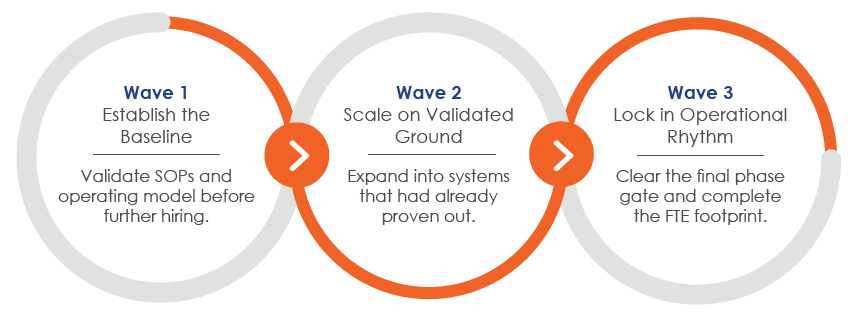
One Operational Model, Rolled Out in Three Waves

Developed from a partnership with DATAMARK, which has engineered financial services back-office transitions for more than three decades. The implementation of the following model was sequenced around five interrelated design decisions.
  1. Locked the requirements before any seats were filled: A PMP-certified project manager ran requirements gathering and stakeholder alignment across more than six departments and fifteen internal stakeholders. The specification was closed and signed off before training began.
  2. Built the operating standard before the team: Independent SOPs were developed to supplement the client’s existing materials and ensure operational continuity through the transition, paired with a proprietary pre-training program that prepared analysts ahead of the client’s LMS. Quality was set as the constraint before any analyst went live.
  3. Phased the team across three waves: Wave one established baseline processes, validated the SOPs in production, and surfaced friction before scaling. Waves two and three inherited a working system. Each wave cleared a defined phase gate before the next began.
  4. Deployed by specialty: The agents were deployed as Underwriting Analysts across multiple specializations for various property types. DATAMARK drew on deep financial services sector experience to tailor each role’s compliance posture and quality controls. Specialization protected per-function quality scores.
  5. Built on Chennai infrastructure already in place: Existing delivery center capacity absorbed the workload; new facilities expanded the footprint as needed. Technology procurement and build-out costs stayed contained, and the financial services compliance posture was already operational on day one—a cost line the executive sponsor never had to defend.

Results

  • Zero change requests during the build and zero carry-over items at handover.
  • 98.39% quality scores against a 90% target, held across all three waves.
  • Kept Turnaround Time (TAT) at 100% and held trainee dropout at zero.
  • Additive runway to 5X full-time agents: more seats inside the same lanes, without structural rework required to scale.
  • Significantly reduced technology procurement and build-out costs: the workload moved into a delivery center operating at compliance grade, without a greenfield build cycle to absorb.

In Conclusion

The implementation of this new operating model delivered a smooth transition with minimal friction, giving the firm a defined path to scale its agent base with the required infrastructure already in place.


Share your love