
Why organizations must test technology with a focus on developing specific use cases.
Artificial Intelligence (AI) is a technology that has been in development for decades. It could even be argued that our modern ideas around AI emerged as far back as the Second World War. Alan Turing was one of the Bletchley Park codebreakers, and he published a famous paper in 1950 asking ‘Can Machines Think?’
For most of the public, the real advances have all taken place in the past three years – ever since OpenAI launched ChatGPT. Within two months of releasing this Generative AI (GenAI) system, it had over 100 million regular users. Now you will have noticed that Google has its Gemini AI system helping with search results, Microsoft has its Copilot, and Anthropic has Claude. AI is all around us now.
This is creating a wave of innovation – companies are creating new products and services that explore how this ability to generate insight from data can be applied. TIME magazine has even called this wave of AI ‘the greatest opportunity of our generation.’
Others are more pessimistic, arguing that new tools scanning and analyzing data much faster than humans means that many professional jobs – those that largely involve interpreting information – may now be at risk.
We are only a few years into this big change in the workplace, so the debate continues to rumble. Like the industry analyst Gartner, I do sometimes believe that new technologies are initially hyped by their creators and the market eventually determines how they can really be used. AI is a tool that can help people to filter data, create summaries of information, and code software… the real question is how we use it rather than worrying about what we will do when robots have replaced us all.
The Rise of Agentic AI
But the latest big trend in this area is Agentic AI, and I am particularly interested in this because it drops neatly into the area of customer experience. Agentic AI takes AI a step further and can initially sound like science fiction because it involves managing a team of digital employees that can all engage in research, make decisions, and report back. It is really the management of autonomous virtual workers. Our own research has found that Agentic AI may soon absorb many of the simpler transactional customer service inquiries.
Last year, the Harvard Business Review predicted that Agentic AI would dramatically change how people work. Imagine a lawyer arriving at work in the morning and checking what his or her virtual team completed overnight, then setting them all off on tasks for the day. Everyone can now manage a team. McKinsey even published a research paper titled ‘The Future of Work is Agentic.’
The Implications for Customer Experience
The implications for customer experience are profound. In a recent podcast from McKinsey, the partners talked to Malte Kosub, cofounder and CEO of Parloa, an agentic AI platform. Mr. Kosub said, “Imagine you’re calling an airline. Right now, you would probably wait in line for 15 minutes, then talk to a different person every single time you called. But now imagine you’re calling an airline, and after one second, your personal AI agent picks up and says, ‘Hey, Christian, how are you? Have you decided if you want to upgrade to business class for your next flight from New York to San Francisco? If not, no worries, just call me back in 20 minutes.’”
Customers can have a personal agentic contact at their favorite brands – their airline or hotel will always remember preferences and past purchases and be able to offer personalized help immediately. This also creates the opportunity for the customer to have their own Agentic AI as a digital assistant. Why call the airline in person when you could instruct your digital assistant to handle the call?
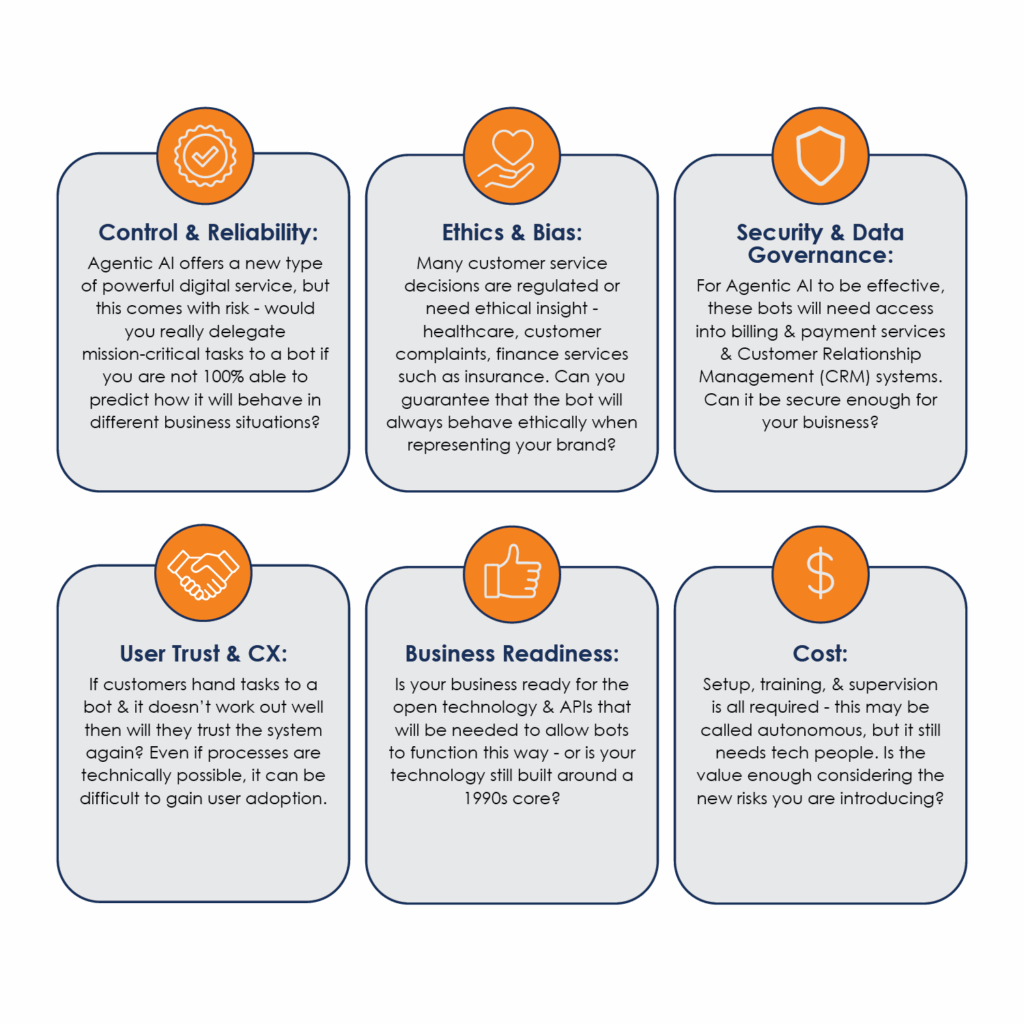
Executives designing the next generation of customer experience need to consider that we may need to start planning for bot-to-bot conversations. Interest in Agentic AI has exploded over the past year. However, although it clearly offers exciting opportunities for both brands and customers – and professional workplaces – there are many caveats.
Challenges and Caveats
Early Results and Lessons Learned
OpenAI recently released their own Agentic AI system for general use. The marketing information suggests that you can now ask this digital assistant to perform almost any information-focused task while you do something else. But even experienced technology journalists have reported some teething problems.
I do feel that Agentic AI is a promising development. It offers the opportunity to give every employee access to productivity-boosting smart digital assistants, and this also offers consumers the ability to let their assistants handle a large amount of mundane personal admin. This is exactly what our DataScribe tool is already delivering – so agents can just focus on the customer, with less admin.
If brands can explore and test this technology with a focus on developing specific use-cases, then both the companies and users may gain the confidence required to trust it, especially important for the brands worried about the integrity of their reputation.
AI is becoming a more important tool in CX. We have already created several tools that are reframing contact center operations using AI, such as DataSmart, which delivers information to agents in real-time based on what the customer needs.
Looking Ahead
In my position, it is essential to always be aware of what is coming down the track – our team has been researching the effect of agentic on CX for many months now. There are already a few real examples of Agentic AI being used for specific services – such as Rocket Money seeking out unused subscriptions – but we will have to see how quickly it becomes used as a more general digital assistant. It’s certainly an area of AI worth following very closely.
Next Steps
If you want to explore what Agentic AI means for contact centers, feel free to set up a complimentary consultation with our team.