
Consolidation is top of mind for the operations and procurement leaders reviewing vendor strategy. The upside is clear, from fewer suppliers and tighter contracts to less overhead to manage. Forrester describes consolidation as the prevailing direction in sourcing right now, while cautioning that many enterprises pursue it as a reactive, cost-cutting measure rather than a deliberate strategy.
On-the-ground sourcing decisions tell a more layered story. Over the past five years, 70 percent of organizations have brought previously outsourced work back in-house, looking to rebuild internal capability and improve service quality, and in part to escape vendor markups. Over the same period, 67 percent moved to outcome-based outsourcing models that pay for measurable results rather than activity.
Rather than handing everything to a few mega-vendors, companies are getting more deliberate about which work goes where and who is accountable for the result. Doing so effectively requires knowing which work is which before you sign anything.
Where a Consolidation Genuinely Pays Off
At the commodity level, consolidation works, especially when a function is standardized and largely undifferentiated. Spreading that function across many suppliers builds integration debt and duplicates tooling. It also widens a third-party risk surface that grows with every contract you sign.
On the other hand, assigning that work to a handful of strategic providers lowers administrative costs and gives procurement stronger negotiating leverage. It simplifies governance, too, with enforcement running through one or two relationships instead of ten.
Insight: For high-volume, rules-based processing where the output looks the same no matter who runs it, a shorter vendor list may be the right call, and the savings tend to show up fast. The mistake is assuming every function benefits from the same consolidation strategy.
The Hidden Cost of Consolidating Too Far
Large providers optimize for standardization because standardization is how they scale. The same machinery that makes a big vendor efficient on commodity volume is what slows it down on bespoke work.
For example, a client might need a process configured to a specific regulatory regime, an unusual claims workflow, or a customer base that behaves differently from anyone else’s. Those requests enter a queue. Customization comes through professional-services engagements that are slow to start and costly to keep running, and by the time the configuration goes live, the business need has often moved on.
This is the trap Forrester points to in describing a client that consolidated more than a dozen systems-integrator relationships into a single one, only to be pressured into an engagement that looked logical on paper but did not fit its actual situation.
Insight: The cost of over-consolidation tends to surface later, in the form of slower response to market change, escalations that generalists cannot resolve, and the quiet workarounds your own team builds because the vendor will not flex.
Cost, as Deloitte’s recent Global Business Services research puts it, has become a deteriorating value proposition, which is pushing providers to diversify the value they deliver. More than half of the organizations Deloitte surveyed named next-generation capability and customer experience as top priorities, ahead of raw savings.
When the value you need is domain depth and speed of adaptation, the largest, most consolidated provider is often the wrong choice. Deloitte’s outsourcing research makes the same case from the other side, noting that specialist managed-service providers earn their keep by mobilizing domain knowledge and advanced technology quickly, without the heavy upfront investment of building it internally.
Core and Edge: A Model That Resolves the Tension
Many of the organizations we work with are finding that they don’t have to choose one or the other. Instead, they’re sequencing consolidation and specialization, in a model pictured as core and edge.
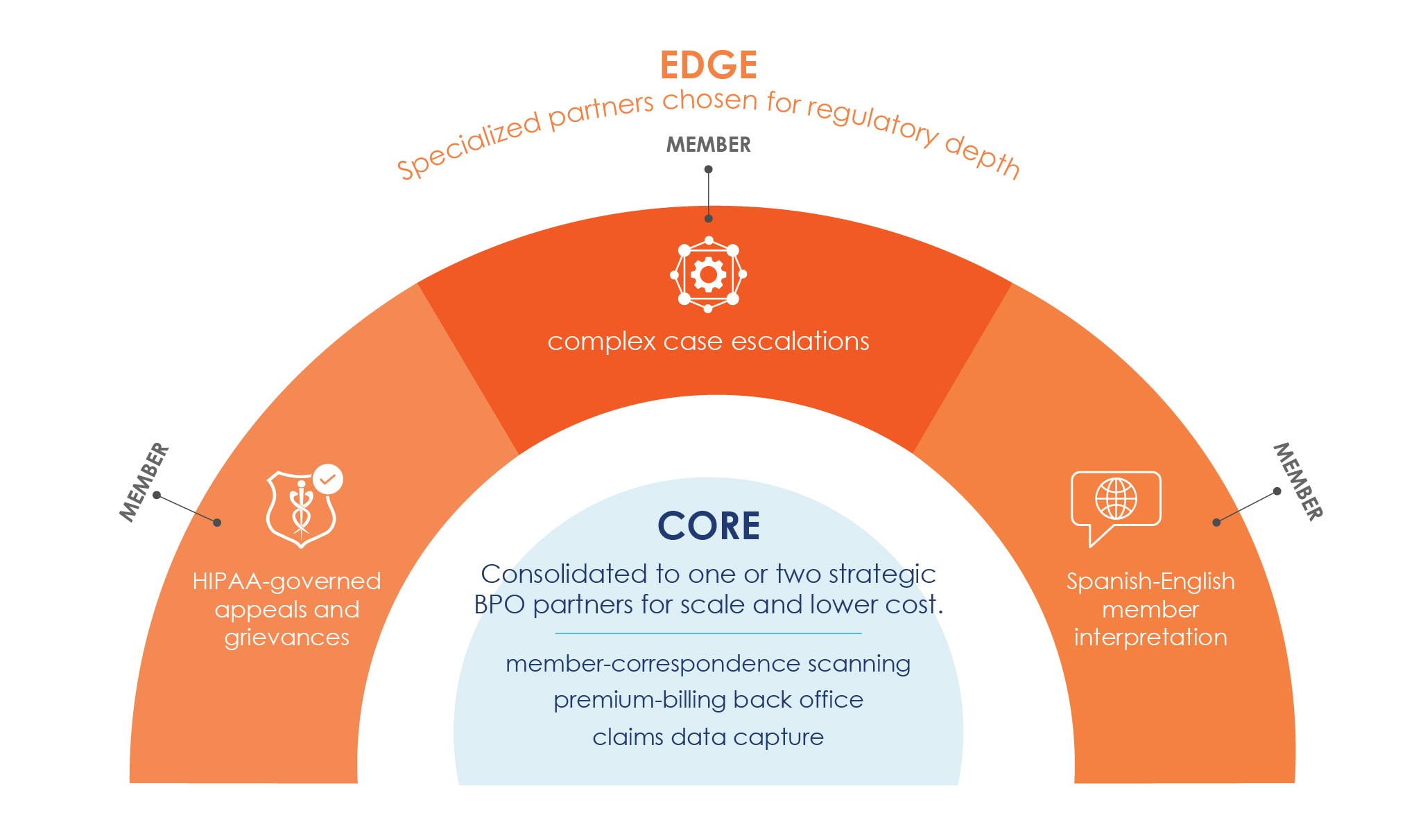
If run well, the core funds the edge. Savings from consolidating commodity work create the budget and the management attention to invest in specialized partners where they move the outcome.
How to Decide What to Consolidate and What to Specialize
Before signing any sourcing decision, sort the function with a few questions:
- Does this work differentiate us, or is it a commodity that looks the same regardless of who runs it?
- Is it regulated or complex enough that mistakes are expensive and specialized expertise is required?
- How tightly is it coupled to customer experience?
- How often will the workflow have to change?
As a general rule, stable, lower-stakes work belongs at the core. Regulated, customer-facing and/or fast-changing work belongs at the edge, with a partner chosen for depth rather than breadth.
Insight: The functions that feel hardest to classify deserve the closest look, because they are often mislabeled as commodity work simply because they’ve always been outsourced that way.
Deliberate Supplier Composition Beats Raw Count
The instinct to simplify a sprawling vendor list is sound, and leaders acting on it are right to do so. The error is treating consolidation as the goal rather than a tool you apply where it fits. Moving forward, the most durable operating models may still carry surprisingly long supplier lists. The difference will be the composition: work consolidated where scale wins, and specialized where depth wins.
DATAMARK runs both ends of this model for enterprise clients, and the edge is where the difference shows up most: regulated, customer-facing operations in which the quality of a single interaction carries real consequences. Consolidation will free up budget and attention either way. Where you reinvest them is what separates a leaner operation from a better one.
If you’re evaluating your sourcing strategy, reach out to DATAMARK to discuss how the right mix of consolidation and specialization can support your business goals.
FAQs About Vendor Consolidation vs. Specialized Partners
Not if the management effort goes where it earns its return. A core-and-edge model concentrates governance on the core, where a few providers handle the bulk of the volume. The edge carries fewer transactions and a lighter coordination load, so the partners you add there cost less to manage than their share of risk would suggest. The overhead problem comes from sprawl without logic, not from deliberate specialization.
Compare total cost, not unit rate. A specialist’s premium buys faster adaptation when rules or volumes shift, along with the escalations and compliance findings that never happen because the work was done right the first time. Outcome-based pricing strengthens the case by tying spend to measurable results rather than activity. The unit rate is visible on the invoice. The savings show up in the problems that never reach you.
Build the exit into the entry. Keep your data in portable formats you control, and document the processes so they don’t live only inside a provider’s playbook. Avoid handing the entire core to a single provider, so you always keep a credible alternative at renewal. Consolidation should lower your administrative cost without costing you your leverage.
It moves the line between them. As automation absorbs more routine, high-volume work, the core gets smaller and cheaper to run, which raises the relative weight of the edge, where judgment and regulatory nuance still need people. Automation also raises the stakes at the edge, because the interactions that reach a human are now the harder ones. The model holds. The boundary keeps shifting toward specialization.
Start with your next renewal. Before that contract comes up, classify the function behind it: commodity work that belongs in the consolidated core, or differentiating work that belongs with a specialist at the edge. Review the portfolio one renewal at a time, and within a cycle or two, it often becomes better aligned without the disruption of a wholesale rebid.